How to document a workflow in NetSuite
By Phil KlingUpdated June 2026How we research this
To document a workflow in NetSuite, record someone performing the real process, a purchase order approval, a vendor setup, or month-end steps, then generate a step-by-step SOP and a process map from it. NetSuite screens depend on role and customization, so written-from-memory guides drift from what users actually see. Ledgerium records the real interaction in the browser and produces the SOP, process map, and a workflow intelligence report, so the documentation matches your account and the role performing the work.
Key takeaways
- NetSuite screens and available actions change by role and permission, so the same purchase order approval looks different to a clerk and an administrator.
- Approval routing in NetSuite depends on amount and subsidiary rules that are easy to leave out of a written guide.
- A NetSuite SOP written from an admin view references menus and actions the role running the work does not actually have.
- Recording the run as the performing role captures the real approval routing and steps for vendor setup, invoice processing, and month-end close.
- Ledgerium produces the SOP, process map, and a report showing where the NetSuite process waits or reworks from one session.
Common workflows in NetSuite
- Purchase order approval routing
- New vendor setup
- Invoice and bill processing
- Month-end close steps
Why documenting them is hard
- Role-based screens mean different users see different steps
- Approval routing depends on amount and subsidiary rules that are easy to miss
- Processes cross NetSuite and other systems, breaking single-system guides
The old way
A finance analyst documents the steps from memory, often from an administrator view that ordinary users never see. The guide references actions and menus the role performing the work does not actually have.
With Ledgerium
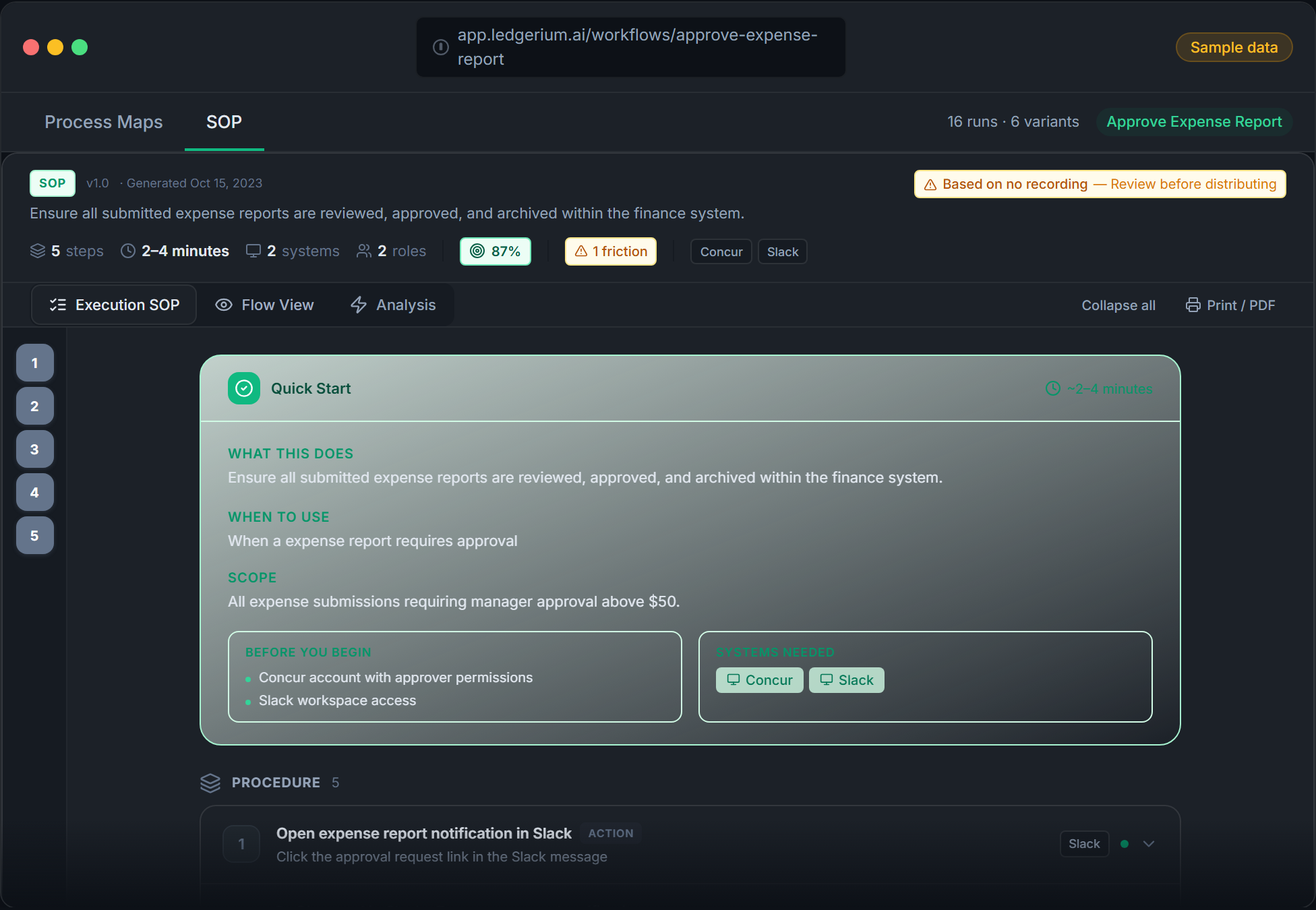
Record the real process as the role that performs it. Ledgerium captures the actual approval routing and steps and generates the SOP, the process map, and a report that highlights where the process waits or reworks.
The SOP Ledgerium generates
Common mistakes
- Documenting from an admin view instead of the role that runs the process
- Leaving approval thresholds and subsidiary rules out of the routing steps
- Stopping at the NetSuite boundary when the process continues elsewhere
How Ledgerium captures this
NetSuite shows different screens and actions to each role, so Ledgerium records the process as the person who actually performs it works, producing an SOP that matches what that role can see and do rather than an administrator view.
1. Install the extension
Add the Ledgerium recorder to Chrome. No screenshots and no keystrokes are ever captured.
2. Record the real workflow
Perform the process once. Ledgerium captures the structured steps, timing, and system context.
3. Get the output
Receive an SOP, a process map, and a workflow intelligence report generated from the real work.
Worth knowing
Ledgerium captures the browser-based steps in NetSuite. Scheduled scripts and back-end workflow actions are not observed directly; document their effect from the user-visible result.
Frequently asked questions
- Record a real run of the process as the role that performs it, then generate the SOP and process map from the recording. The result reflects what that role actually sees and does in your account.
- NetSuite screens and actions depend on role, permission, and customization. A guide written from an admin view or from memory references steps that ordinary users do not have. Recording the real role avoids that gap.
- Yes. It records the approval steps as they happen in the browser, including the routing the user follows, so the SOP and process map show the real approval path rather than an idealized one.
- It captures what the user does and sees in the browser. Scheduled scripts and server-side workflow actions are not observed directly, so document their effect from the user-visible result.
- No. This is an independent guide. NetSuite is a trademark of its owner, and Ledgerium is not affiliated with or endorsed by NetSuite.
Related to this
Free includes SOPs and process maps for 5 workflows a month. The intelligence layer — bottleneck detection, automation scoring, variation analysis — is on paid plans. See what's included on each plan.
Not ready to sign up? Try the live demo — no login required.
Document a NetSuite workflow from real work
Record the real process in your own account and generate an SOP, a process map, and an intelligence report that matches what your team actually sees.
Free plan includes 5 documented workflows per month. No screenshots ever captured.
Or Install the extension first.
NetSuite is a trademark of its respective owner. Ledgerium AI is not affiliated with or endorsed by NetSuite.